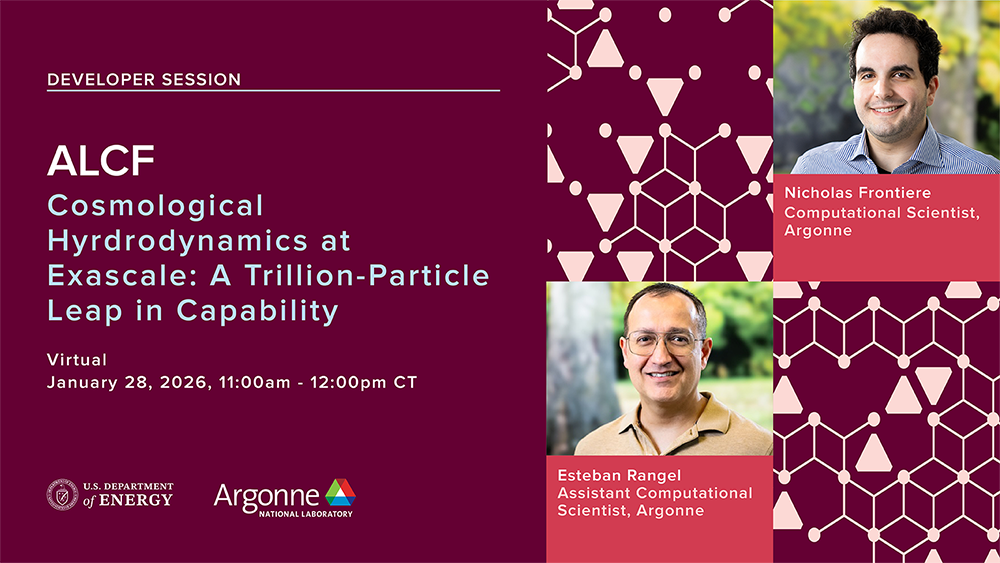
Please join us on January 28, 2026, for a webinar on “Cosmological Hydrodynamics at Exascale: A Trillion-Particle Leap in Capability.”
In this webinar, we will explore how exascale cosmological simulations are transforming our ability to model large-scale structure at unprecedented scale and fidelity. Resolving the most fundamental questions in cosmology requires simulations that match the scale, fidelity, and physical complexity demanded by next-generation sky surveys. To achieve the realism needed for this critical scientific partnership, detailed gas dynamics must be treated self-consistently with gravity for end-to-end modeling of structure formation. Exascale computing enables simulations that span survey-scale volumes while incorporating key astrophysical processes that shape complex cosmic structures.
We present results from CRK-HACC, a cosmological hydrodynamics code built for extreme scalability. Using separation-of-scale techniques, GPU-resident tree solvers, in situ analysis pipelines, and multi-tiered I/O, CRK-HACC executed Frontier-E: a four-trillion-particle full-sky simulation, over an order of magnitude larger than previous efforts. The run achieved 513.1 PFLOPs peak performance, processing 46.6 billion particles per second and writing more than 100 PB of data in just over one week of runtime. Frontier-E marks a significant advance in predictive modeling for next-generation cosmological science.
Nicholas Frontiere is one of the developers of the numerical cosmology code HACC (Hardware/Hybrid Acceleration Cosmology code). Contributing since 2012, he has been actively researching novel numerical hydrodynamic methods, particularly advancements in Smoothed Particle Hydrodynamic schemes; playing a leading role in developing Conservative Reproducing Kernel SPH (CRK-SPH), a framework that overcomes many of the problems of the original SPH technique, while maintaining many of its advantages. He is also presently investigating new extensions to galactic formation subgrid modeling suitable for large scale cosmology simulations.
Nick has been developing high performance codes at multiple national laboratories for many years. His contributions to HACC have been directed towards performance and scalability on supercomputing hardware. He was a lead developer in HACC’s 3D parallel FFT, scalable to millions of ranks, which is now available separately as the DOE ECP-supported SWFFT package. He also developed the GPU accelerated gravity-only solver in HACC. Both activities contributing to the HACC team becoming ACM Gordon Bell Finalists in 2012 and 2013. Nick is presently combining his research in hydrodynamic and subgrid advancements with novel GPU acceleration aimed at achieving high performance on a variety of current and next-generation accelerators.
Esteban Rangel is a computational scientist with broad interests in solving large-scale scientific computing problems using HPC platforms. Esteban’s research focuses on preparing scientific applications for the Aurora supercomputer, particularly optimizing for Intel’s latest GPU technology. His work spans both computation and data, from developing new approaches to make codes run efficiently across different architectures to exploring large-scale input/output strategies with advanced storage systems like DAOS. He is also interested in methods for ensuring numerical reliability in simulations, including new ways to study precision and accuracy in high-performance computing.